
AI, Authorship and Interactive Fashion Publishing
Reflecting on human creative contributions in AI-assisted moving images, and how audiences experience creative work, through a conversation with one of the creators of 12-45.
01 / WHY I WANTED TO SPEAK WITH MARTIN
Throughout my WATERMARK research, I have been exploring how human creative contributions can become more visible in AI-assisted moving image practice.
My previous interventions mainly focused on audiences. I wanted to understand how people respond to AI-generated images and what kind of information might help them recognise the contributions of human creators.
But I also wanted to hear from people who actually work with AI in their creative practice.
Through an introduction from my tutor, Diane, I had the opportunity to exchange emails with Martin Sparkes.
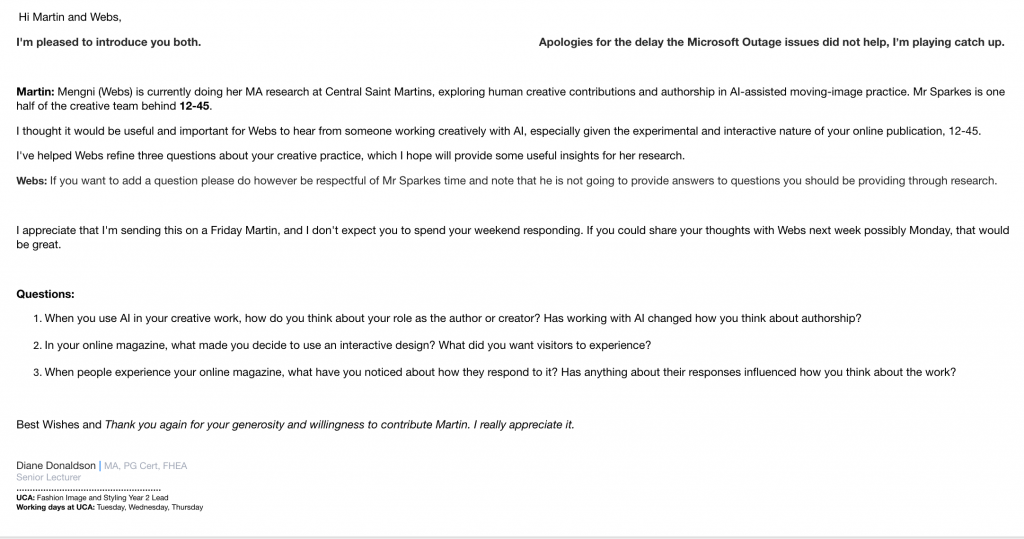
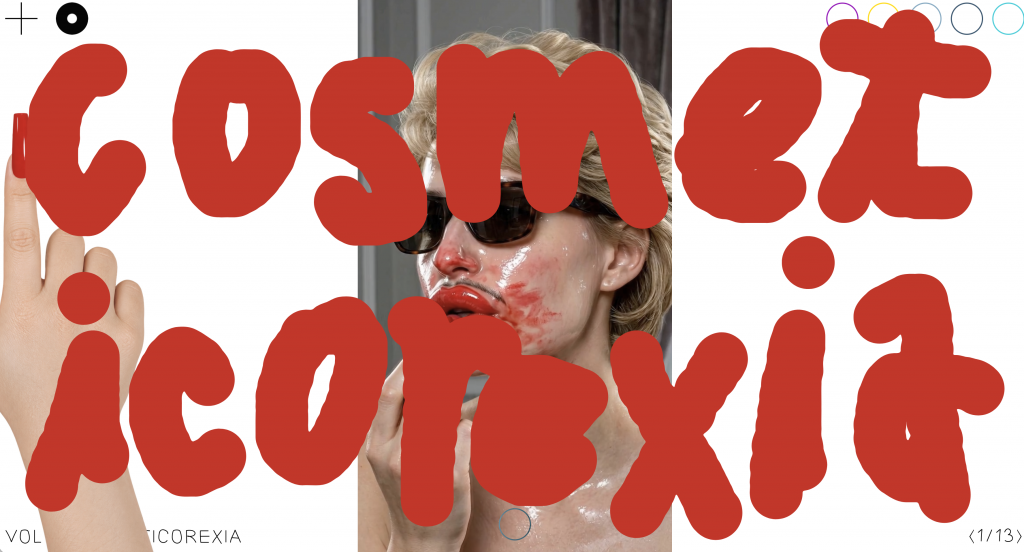
Martin and Pedro Carrilho are the creative team behind 12-45, an experimental digital fashion magazine.
Rather than following the format of a traditional online magazine, 12-45 brings together AI, digital technology and interactive design to explore different ways of presenting fashion imagery and how audiences might engage with it.
12-45 Official Website: https://12-45.xyz/

I wanted to know how he thinks about authorship when different tools and technologies are involved in the creative process.
I was also curious about why they chose an interactive format for the magazine, and how visitors respond to that experience.
Our conversation focused on three areas: AI and authorship, the interactive design of 12-45, and audience responses.
02 / WHEN AI BECOMES A CREATIVE TOOL, WHO IS THE AUTHOR?
Martin and his creative partner see themselves as the authors, creative directors and instigators of their work. For them, AI is another tool within their creative practice.
He explained that their process doesn’t simply begin and end with writing a prompt. They start with an idea, develop a visual language, experiment with different possibilities and make decisions about the results.
One part of his response particularly stayed with me:
“The decisions about what to retain, reject, manipulate or develop further remain mine.”
Martin explained that AI sometimes produces unexpected results that take a project in a different direction. But the decisions about what to keep, reject, change or develop further still belong to the creator.
He also mentioned that both he and his creative partner have around thirty years of experience in their respective practices. Whether they work by hand, with machines or through software, the creative process has always been an important part of their work.
This made me think again about the questions I have been exploring through WATERMARK.
When we only see the final image, it can be difficult to know what decisions the creator made along the way.
And those decisions don’t always leave visible traces in the finished work.
Martin also said that working with AI has made him think more consciously about authorship. For him, authorship is not necessarily defined by who physically produces an image. It also comes from the ideas, intentions, direction and decisions behind it.
However, he also recognised the questions AI raises around originality, ownership, influence and the sources used to generate images.
I think this is an important distinction.
Making human creative contributions visible doesn’t mean we can ignore questions about copyright and where AI-generated content comes from.
For WATERMARK, it reminded me that showing someone’s creative decisions and explaining the sources of a work are connected, but they are not exactly the same thing.
03 / WHY MAKE A MAGAZINE INTERACTIVE?
Apart from authorship, I was also interested in why 12-45 was designed as an interactive experience.
Martin explained that they didn’t want to simply transfer a traditional printed fashion magazine onto a screen.
Instead, they wanted to explore what an online fashion magazine could become.
In 12-45, visitors are not limited to viewing images and text in a fixed order. They can explore and interact with the content in their own way.
The website itself becomes part of the creative work, rather than just a platform for displaying it.
Martin also explained that they wanted visitors to feel as though they were entering a creative environment, rather than simply reading a magazine.
The experience could be unexpected, and not everything needed to be immediately clear.
They wanted people to spend time exploring, discovering relationships between images and becoming curious about what they were seeing.
He described the experience as something between a fashion magazine, a digital exhibition and an experimental visual playground.
This made me think about WATERMARK from another perspective.
Previously, I had been more focused on what creative information should be shown to audiences.
But Martin’s approach to interactive design made me realise that how people experience information might be just as important as the information itself.
If WATERMARK could eventually become an interactive visual experience, perhaps audiences wouldn’t need to receive all the information at once.
Instead, they could explore and gradually discover the different decisions behind a moving image.
Of course, this is still an idea I have taken from the conversation, rather than something I have tested.
04 / HOW DO AUDIENCE RESPONSES INFLUENCE THE WORK?
Martin also shared some of the responses they have noticed from visitors to 12-45.
He explained that people experience the magazine differently depending on how familiar they are with fashion, imagery and technology.
Some visitors initially approach it as they would a conventional online magazine, but gradually become more interested in how the content is presented and how they can interact with it.
Others are immediately drawn to the visual experiments and the use of digital technology.
He also mentioned that AI-generated imagery can make people question what they are looking at, particularly when it challenges their understanding of photography, realism and representation.
For Martin, these reactions are important.
He doesn’t necessarily want the work to provide clear answers. He is interested in creating images and experiences that raise questions, encourage discussion and make people look at fashion imagery differently.
This reminded me of my previous audience interventions at Somerset and Frieze.
During those experiments, I found that explaining how something was made didn’t necessarily mean people would value its creativity more.
Sometimes, giving people more information simply led to more questions.
Martin’s response made me think about this differently.
Perhaps an audience asking questions doesn’t always mean that the communication has failed.
But for WATERMARK, I still need to understand the difference between people being curious about a visual experience and people actually understanding human creative contributions.
These are not necessarily the same thing.
05 / WHAT DOES THIS MEAN FOR WATERMARK?
This conversation made me reconsider two questions.
First, which creative decisions are worth making visible?
Martin’s understanding of authorship made me pay more attention to the choices, rejections, adjustments and judgements involved in creative work, rather than simply listing the production steps.
Second, how should audiences experience this information?
The interactive design of 12-45 made me wonder whether WATERMARK could allow people to explore the information behind an image, rather than simply reading an explanation added to the final work.
But I also realised that interaction doesn’t automatically lead to understanding.
An interesting visual experience doesn’t necessarily help people recognise the creator’s contribution.
So, I want to continue exploring which kinds of creative information are worth showing, and whether different visual and interactive approaches can influence how audiences understand them.
Martin’s feedback didn’t give me a ready-made answer for WATERMARK, but it helped me think about both the creator’s decisions and the audience’s experience.
It’s not only about what we make visible, but also how people come to see it.
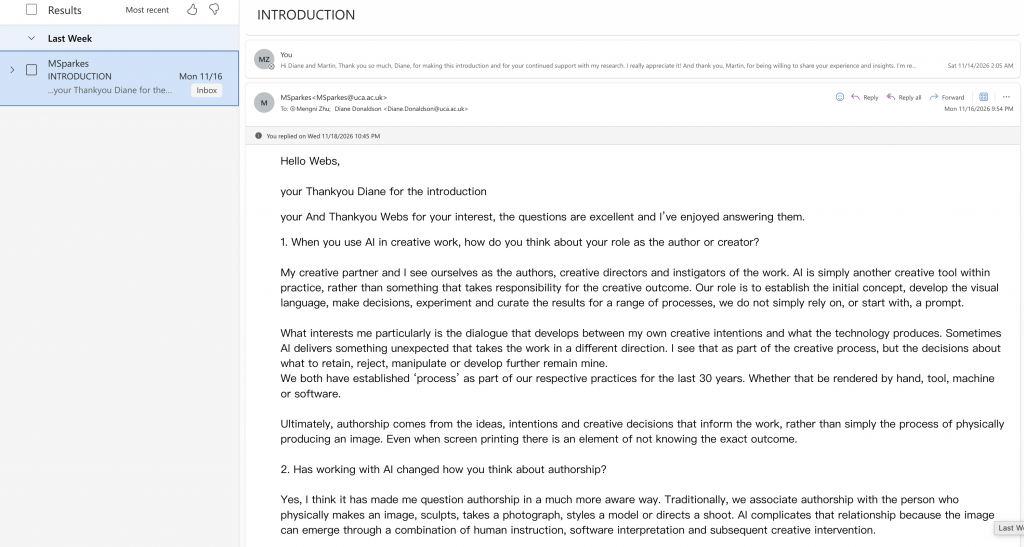
Sparkes‘s Original Email
Hello Webs,
your Thankyou Diane for the introduction
your And Thankyou Webs for your interest, the questions are excellent and I’ve enjoyed answering them.
1. When you use AI in creative work, how do you think about your role as the author or creator?
My creative partner and I see ourselves as the authors, creative directors and instigators of the work. AI is simply another creative tool within practice, rather than something that takes responsibility for the creative outcome. Our role is to establish the initial concept, develop the visual language, make decisions, experiment and curate the results for a range of processes, we do not simply rely on, or start with, a prompt.
What interests me particularly is the dialogue that develops between my own creative intentions and what the technology produces. Sometimes AI delivers something unexpected that takes the work in a different direction. I see that as part of the creative process, but the decisions about what to retain, reject, manipulate or develop further remain mine.
We both have established ‘process’ as part of our respective practices for the last 30 years. Whether that be rendered by hand, tool, machine or software.
Ultimately, authorship comes from the ideas, intentions and creative decisions that inform the work, rather than simply the process of physically producing an image. Even when screen printing there is an element of not knowing the exact outcome.
2. Has working with AI changed how you think about authorship?
Yes, I think it has made me question authorship in a much more aware way. Traditionally, we associate authorship with the person who physically makes an image, sculpts, takes a photograph, styles a model or directs a shoot. AI complicates that relationship because the image can emerge through a combination of human instruction, software interpretation and subsequent creative intervention.
It has made me think more about authorship as a process of direction, selection, manipulation and curation. I don’t necessarily believe that using AI makes someone less of an author. In many ways, it places greater importance on having a clear creative vision and understanding what you want to communicate.
However, it also raises important questions around originality, ownership, influence and the sources from which AI generates its imagery. I think these are conversations that the fashion image industry needs to engage with rather than avoid.
3. In your online magazine, what made you decide to use an interactive design?
We wanted to challenge the traditional idea of what an online fashion magazine could be. We didn’t want to simply transfer the experience of a printed magazine onto a screen, or create something that functioned as a digital version of a conventional publication. We enjoy process, so using a range of tools and process as a means to adapt or present work was a natural decision.
An interactive format allows the reader to become more involved in navigating the content, rather than being a passive observer.
The decision was also driven by an interest in the relationship between fashion image, technology and contemporary visual communication. We wanted the design to reflect the experimental nature of the imagery and the ideas behind the publication. The website itself becomes part of the creative work, rather than simply a platform for displaying it.
4. What did you want visitors to experience?
We wanted visitors to experience something that was visually engaging, unexpected and perhaps a little unconventional. I wanted them to feel that they were entering a creative environment rather than simply reading a magazine.
Fashion imagery, to me, has always been about creating a feeling, communicating an identity and constructing a narrative. I wanted to extend that experience into the digital environment, allowing visitors to explore, discover and interact with the content in their own way.
We aren also interested in creating a degree of curiosity. We didn’t necessarily want everything to be immediately obvious or predictable. We wanted people to spend time exploring the website, discovering different visual relationships and questioning what they were looking at.
Ultimately, we wanted the experience to blur the boundaries between a fashion magazine, a digital exhibition and an experimental visual playground.
5. When people experience your online magazine, what have you noticed about how they respond to it?
One of the things I am interested in is how people respond differently depending on their relationship with fashion, imagery and technology.
Some people initially approach it with the expectations of a conventional online magazine, but then become more curious about the way the content is presented and how they can interact with it. Others are immediately drawn to the visual experimentation and the unexpected relationship between fashion imagery and digital technology.
I think there is also an interesting moment when people begin to question what they are looking at, particularly when AI-generated imagery challenges their understanding of photography, realism and representation.
For me, that response is important. I don’t necessarily want the work to provide straightforward answers. I am interested in creating images and experiences that provoke questions, generate discussion and encourage people to look at fashion imagery differently.
6. Has anything about their responses influenced how you think about the work?
Yes. It has reinforced my belief that the experience of fashion imagery is changing, and that we need to think beyond the image as a finished, static outcome.
What interests me is the relationship between the creator, the image, the technology and the audience. The audience is no longer simply looking at something that has been presented to them; they can become involved in navigating, interpreting and experiencing the work.
Ultimately, I see 12-45 as an ongoing creative experiment. It gives me an opportunity to question established conventions of fashion imaging and explore how emerging technologies can create new possibilities for fashion image-making, storytelling and audience engagement. I think the most interesting aspect is not necessarily what the technology can do, but what we, as creatives, choose to do with it.
Human creativity remains central: AI is a means of extending creative possibilities, not replacing creative vision, judgement or authorship
I hope this helps,
References
12-45 — Experimental Digital Fashion Magazine
Created by Pedro Carrilho and Martin Sparkes.
Website: https://12-45.xyz/
Sparkes, M. (2026). Written responses to interview questions on AI, authorship, interactive design and audience experience. Personal email correspondence, November 2026.