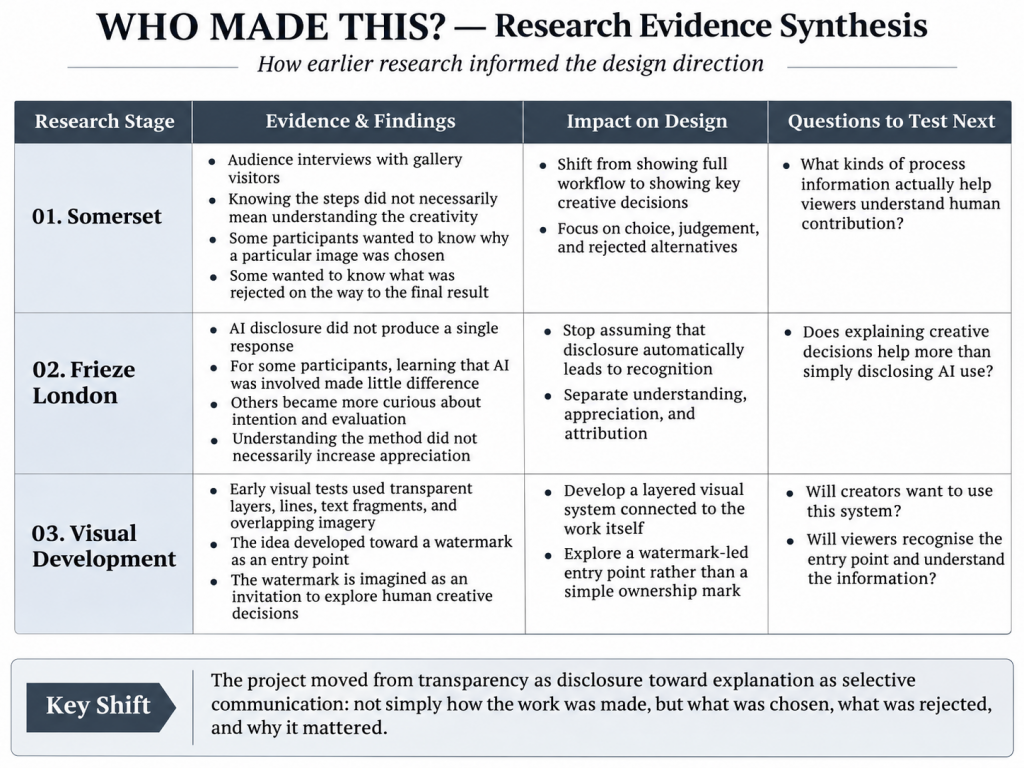
As I continued developing WHO MADE THIS?, I realised that my previous interventions were not simply separate research activities. Together, they revealed a gap between making creative processes visible and helping people understand the human decisions behind them.
My first intervention at Hauser & Wirth Somerset explored whether explaining the production process of an AI-assisted moving image could help audiences recognise human creative contributions. However, some participants were less interested in a list of production steps and more interested in why particular creative choices had been made. They wanted to understand what had been selected, what had been rejected, and why those decisions mattered.
At Frieze London, I explored a different question: how does knowing that AI was involved influence people’s evaluation of a work? The responses were varied. For some participants, AI disclosure made little difference to their judgement, while others became more curious about the creator’s intentions. This reminded me that understanding how something was made does not necessarily mean appreciating it more.
Looking across these two interventions, I began to question my original assumption that greater transparency would automatically make human creative contributions easier to recognise.
The issue may not simply be how much information is disclosed, but which information is communicated and how it is presented.
This reflection has influenced the next stage of my visual development. Rather than presenting a complete production workflow, I am exploring a layered visual system that allows creators to selectively reveal significant creative decisions.
One direction I am investigating is the possibility of rethinking a watermark as more than a marker of identity or ownership. What if it could also become part of a creator’s visual expression and offer viewers an entry point into the thinking behind a finished work?
Importantly, this remains a design hypothesis rather than a proven solution. My earlier interventions involved viewers, and I still need to investigate what creators themselves would be willing to share, whether a watermark is an appropriate format, and whether this information genuinely helps viewers understand human contribution.
My research is gradually shifting from asking how to make more of the creative process visible, towards asking what is worth making visible, for whom, and why.
For me, this is the next question that WHO MADE THIS? needs to explore.