
Case Study: You Only Have Seven Seconds (2025) — Weidi Zhang and collaborators
https://www.zhangweidi.com/youonlyhavesevenseconds
01. From AI-Generated Images to Human Creative Decisions
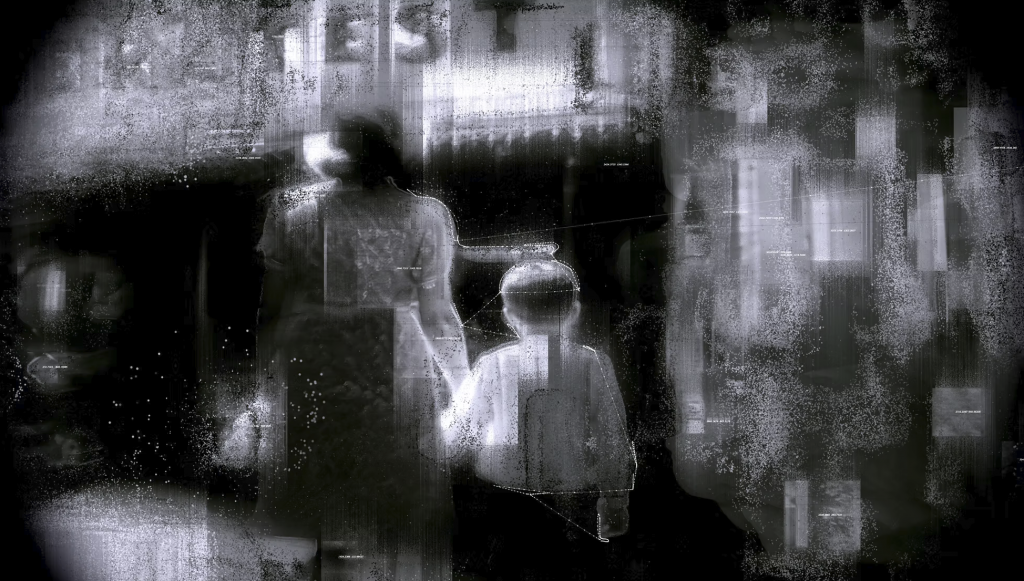
As part of my ongoing research into how human creative contributions can be made more visible in AI-assisted moving-image practice, I explored You Only Have Seven Seconds (2025), a five-minute experimental film developed from the participatory AI installation ReCollection.
The project invited participants to share short personal memories, which were transformed through AI into text and visual material. The artists then selected 64 sets of materials and developed them into a cinematic work through narrative organisation, visual transformation, editing and sound design.
What interested me most was not the AI-generated imagery itself, but the human creative decisions that shaped the final film.
AI contributed to producing visual material, yet the artists made decisions about which memories to include, how different voices could be connected, and how the audience would experience the relationship between personal and collective memory.
This made me reconsider an important question in my own research:
If AI generates the visual material, where does meaningful human creative contribution actually take place?
02. Distributed Creative Agency
One theoretical perspective I found relevant is Distributed Creative Agency, which can be explored through Actor–Network Theory and Lucy Suchman’s work on human–machine relations.
Rather than understanding creativity as the action of one individual, this perspective encourages me to examine how different people, technologies and materials contribute to a creative process.
In You Only Have Seven Seconds, creative contributions can be understood across several roles:
Participants contributed their personal memories.
AI systems transformed text and generated visual material.
Artists selected, organised and interpreted these materials.
Cinematic and sound decisions shaped the final experience.
However, these contributions are not necessarily equivalent. Contributing original material, generating an image and determining the narrative meaning of a film involve different kinds of agency.
This distinction is important to my research because I am not simply asking whether humans or AI should receive credit. I am investigating what kinds of human decisions audiences recognise as meaningful contributions, and why.
03. Curation and Postproduction as Creative Authorship
Another relevant theoretical connection is Nicolas Bourriaud’s Postproduction (2002), which discusses artistic practices that select, reorganise and transform existing cultural materials.
In the film, the artists did not simply present AI-generated images as finished works. They selected memories, organised them into themes, connected different voices and developed a visual language to express the instability of memory.
One particularly interesting decision was the arrangement of different people’s memories to initially suggest a single narrative voice, before gradually revealing their collective origins.
This suggests that creative contribution may emerge not only through generating new material, but also through selecting, rejecting, arranging and transforming existing material.
It also connects to my own AI-assisted moving-image practice. I have often removed unwanted generated elements or changed transitions to create a particular emotional or narrative effect.
Although these decisions influence the final work, they may be difficult for audiences to recognise simply by watching the finished video.
04. From Documentation to Meaningful Transparency
This case study also challenged my understanding of transparency.
The artists provide detailed explanations of their process, including data collection, AI transformation, material selection and cinematic production. These explanations make aspects of the collaboration visible.
However, making a creative process visible does not necessarily mean that an audience understands the significance of the human contributions within it.
This distinction directly relates to feedback from my previous intervention. Five out of eight participants preferred information about creative decisions, but this preference did not demonstrate that their understanding had actually increased.
I therefore need to distinguish between three concepts:
Disclosure: What information about the creative process is revealed?
Recognition: Which human contributions can audiences identify?
Understanding: Can audiences explain why these contributions matter to the final work?
This has become an important direction for my research into meaningful transparency.
Rather than assuming that more information leads to better understanding, I want to investigate which information is useful, how it should be presented and how changes in audience interpretation can be observed.
05. Implications for My Practice
This research has influenced the next stage of my project, WHO MADE THIS?, a participatory creative investigation into human contribution in AI-assisted short-form video production.
I plan to develop a Creative Decision Map that documents significant human decisions within my own AI-assisted filmmaking process, including creative intention, selection, rejection, transformation and narrative direction.
These records will inform different transparency prototypes that audiences can experience and compare.
My next intervention will examine how participants interpret human contributions before and after selected creative-process information is revealed.
I will look beyond whether participants prefer a particular type of information and instead analyse the specificity of their explanations, the evidence they use and any changes in their interpretations.
06. Critical Reflection and Next Steps
Before exploring this case study, I was primarily concerned with how to make creative contributions more visible.
I am now beginning to question whether visibility alone is an adequate research objective.
A creative process involves many contributions, but not all information is equally meaningful to every audience. The way information is selected and presented may influence whose work becomes recognised and whose remains overlooked.
This leads me to a more focused question within my existing research:
How can selected information about human creative decisions help audiences develop a more informed understanding of creative contribution in AI-assisted moving images?
My next steps are to conduct further interviews with AI-assisted creators, document real creative decisions in my own practice and test how different forms of disclosure influence audience interpretation.
The aim is not to prove that transparency is always beneficial, but to investigate what meaningful transparency could look like, for whom, and under what conditions.
References
Bishop, C. (2012) Artificial Hells: Participatory Art and the Politics of Spectatorship. London: Verso.
Bourriaud, N. (2002) Postproduction: Culture as Screenplay: How Art Reprograms the World. New York: Lukas & Sternberg.
Suchman, L.A. (2007) Human–Machine Reconfigurations: Plans and Situated Actions. 2nd edn. Cambridge: Cambridge University Press.
Zhang, W. et al. (2025) ‘You Only Have Seven Seconds: From Intimate Whispers to Shared Worlds in Participatory Data-Driven Cinematic Art’, 2025 IEEE VIS Arts Program. Available at: https://doi.org/10.1109/VISAP.2025.00015
Zhang, W. et al. (2024) ‘ReCollection: Creating Synthetic Memories with AI in an Interactive Art Installation’, Proceedings of the ACM on Computer Graphics and Interactive Techniques, 7(4). Available at: https://doi.org/10.1145/3664207