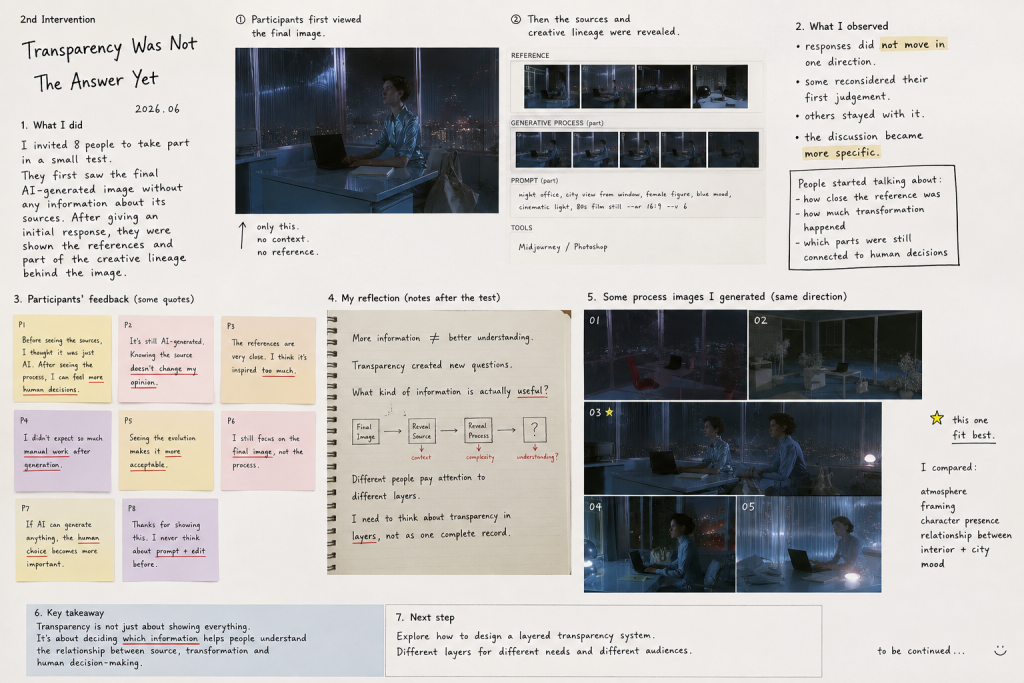
After shifting my attention from copyright to transparency, I wanted to see whether revealing more of the creative process would actually change how people understood an AI-generated work.
I tested an early version with eight participants.
They first saw the final image without any information about its sources. After giving an initial response, they were shown the references and part of the creative lineage behind the image.
What interested me was that the responses did not move in one direction.
Some people reconsidered their first judgement after seeing the sources, while others stayed with it. The discussion also became more specific. Instead of only asking whether the image was “original”, people started talking about how close the reference was, how much the image had been changed, and which parts of the process still felt connected to the creator.
I had expected transparency to make the situation clearer.
It did not.
Revealing the source gave people more context, but it also created new questions. A reference could be visible without explaining how it had been used. A prompt could be shown without telling us much about the decisions made afterwards. Even a complete list of tools would not necessarily explain where the important creative choices happened.
This became a useful problem for me.
Until then, I had treated transparency almost as if it were automatically positive: if more information was available, people would understand the work better.
The intervention made that assumption harder to keep.
The question was no longer simply whether the process should be transparent.
I needed to ask:
Which information actually helps someone understand the relationship between source, transformation and human decision-making?
That question later became the basis for thinking about transparency in layers rather than as one complete record.