In my last blog, I wrote about using web coding and interactive experiences to show the creative process behind AI-generated images.
At that time, I was thinking a lot about the form of my project. Should it be a website? An interactive artwork? Or maybe a moving image?
But after my tutorial, I realised that I was thinking about the medium too early.
One question from the tutorial stayed in my mind:

I think this is a simple question, but I didn’t really have a clear answer at that moment.
Recently, I have been looking at many new tools, especially AI, vibe coding and different creative coding projects. These things are changing very fast, and every week I can see something new online. Sometimes I feel I need to keep learning them because I don’t want to miss what is happening.
But I also started to feel that the more tools I looked at, the more confused I became about my own project.
I was thinking too much about how to make something, instead of what I actually want to understand.
From originality to creative decisions
At the beginning of my research, I was very focused on originality.
But after making some AI images and short films, I started to feel that it is difficult to only discuss whether an AI image is original or not. It is very subjective, and different people can have completely different opinions.
For me, something more interesting happens during the process.
When I make an AI image or film, I don’t only write a prompt and wait for an image.
I choose references.
I change the story.
I reject a lot of results.
I change the composition.
Sometimes I go back to the beginning and try another direction.
And finally, I decide which image feels right for the project.
So I started thinking:
Maybe my contribution is not only inside the final image. Maybe it is also inside all these decisions.
But normally, when someone sees the final work, they cannot see these decisions.
This brought me back to the idea of transparency.
Instead of only asking:
Is this AI-generated image original?
I started to ask:
What happens if people can see the creative decisions behind it?
And maybe more importantly:
Where is the human creator inside an AI creative process?
Can AI help me build my own visual language?
There was another question from my tutorial that I kept thinking about.
I said that one of my personal goals is to develop my own visual language. Then I was asked whether this is really possible with AI.
I found this question quite difficult.
I came to CSM partly because I wanted to explore my own way of making visual work. I don’t want to only learn new software or make images that look like current AI trends. I want to understand what makes something feel like my work.
But at the same time, I am using AI more and more.
This feels a little contradictory to me.
I want to use AI to make something personal, but AI itself is learning from a huge amount of existing visual material.
So I started asking myself:
If I only write a prompt and AI generates everything, what part of the image is actually mine?
Maybe I need to put more of my own material into the process.
For example:
My photograph / video / idea
↓
AI transformation
↓
My selection
↓
My editing
↓
Final work
This feels different from:
Text prompt
↓
AI generation
↓
Final image
I don’t know yet if one process will feel more personal than the other.
So instead of trying to answer it by myself, I want to test it.
My first intervention
For my first small intervention, I want to compare these two ways of working with AI.
Process A
Participants start with only a text prompt.
Text Prompt → AI Generation → Selection → Final Image
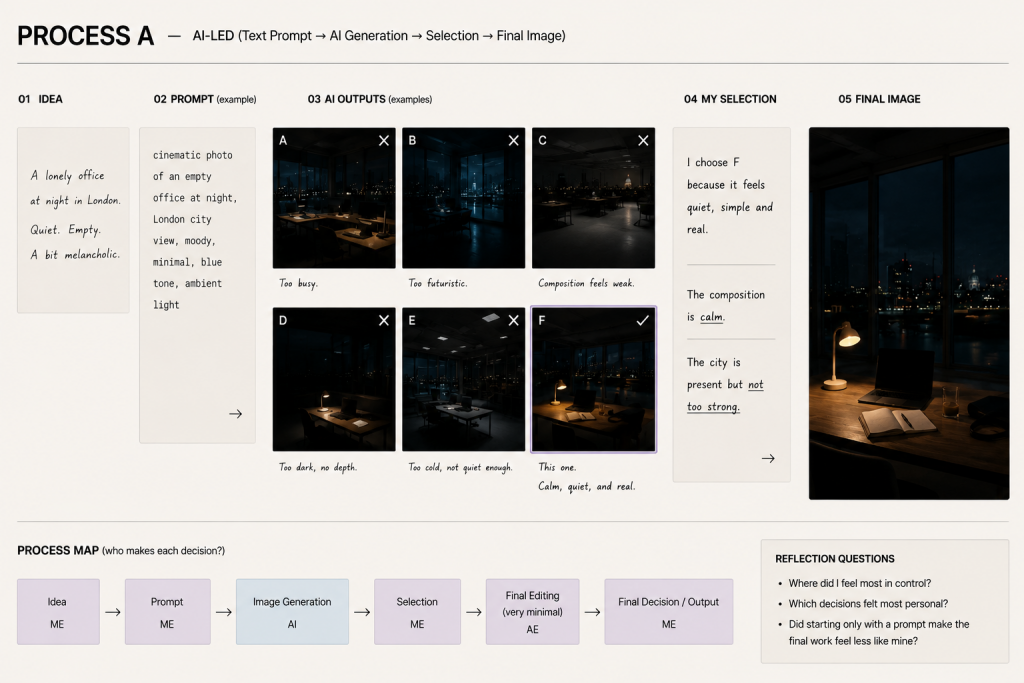
Process B
Participants start with something from themselves, for example their own photograph, video, drawing or previous work.
Personal Material → AI → Selection / Changes → Editing → Final Image
I want to invite a small number of people with creative backgrounds to try both processes.
I am not trying to prove which process is more original.
I am more interested in how they feel when they are making something.
I want to ask:
- At what point did the work start to feel like yours?
- Which decision felt most personal to you?
- Did using your own material change how you felt about the final result?
- Which parts felt controlled by you, and which parts felt controlled by AI?
- If I only showed the final image to another person, what part of your contribution would they not be able to see?
I also want to observe what happens during the process, not only collect their final answers.
For example, when do they reject an AI result? When do they decide to change direction? Which details do they care about? And when do they feel that the image is “right”?
What am I actually testing?
After writing down this intervention, I think I can answer the question from my tutorial a little more clearly.
I am not really trying to test whether AI is original.
At this stage, I am more interested in where people feel their own authorship exists when they work with AI.
Maybe it is in the original material.
Maybe it is in the idea.
Maybe it is in the prompt.
Maybe it is in the selection and editing.
Or maybe it is spread across the whole process.
I don’t know yet.
And I think this is exactly why I need to do the intervention.
My next step is to stop adding more ideas for a while and actually test this with other people. So far, most of these questions have come from my own experience of working with AI. I am curious whether other creatives have similar feelings, especially when deciding which parts of their process they are comfortable sharing with AI and which parts they still want to keep for themselves.
At this stage, I don’t know whether this is mainly my personal struggle or something more common among creatives working with AI. I think speaking to other people and looking at how they actually use AI in their practice could help me understand what I should test next.