Building My Network: Who I’m Talking To and Why
The starting point was Xiaohongshu — specifically, the growing frustration of hand-crafting artists watching their work get absorbed into AI-generated content without credit or acknowledgment. That pattern of quiet appropriation is what shaped my research question. And because I’d spent seven years inside China’s fashion and entertainment industries, I already knew who I needed to ask about it.
What three conversations taught me
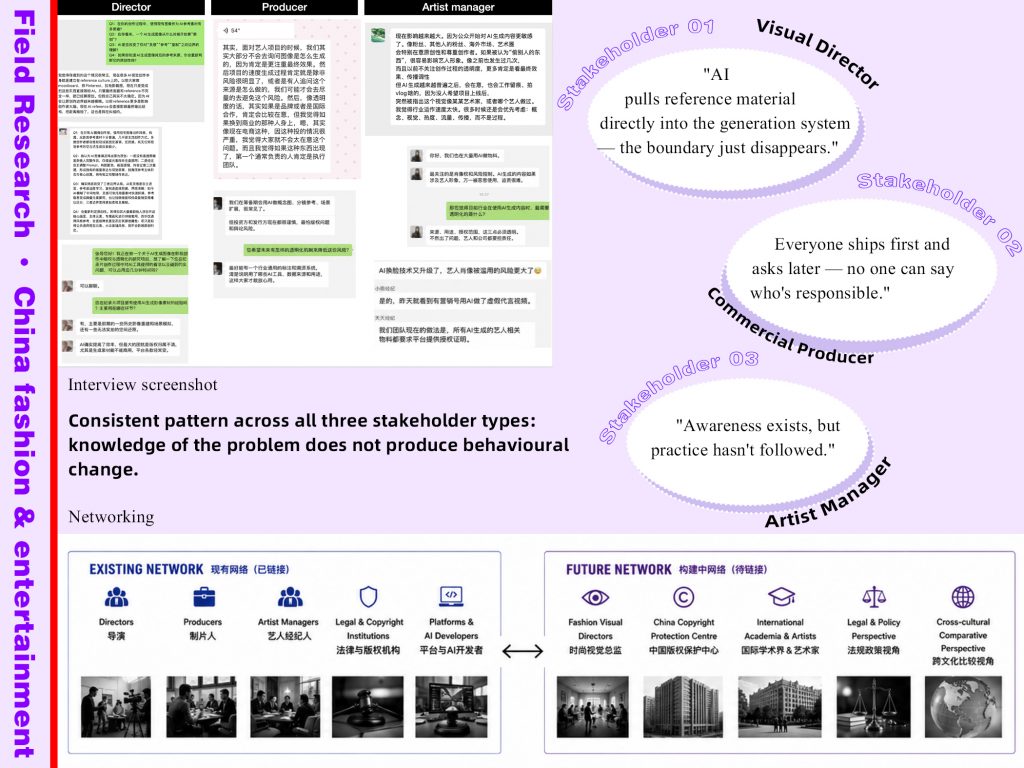
The first was with Yang, a Shanghai-based visual director with a background in pioneering commercial and fashion work. Her answer was direct: using existing images as AI reference is standard practice. Before AI, everyone built moodboards, pulled Pinterest, and assembled film stills. Now those same references get fed straight into the generation system. “AI pulls reference material directly into the generation system — the boundary just disappears,” she told me. What stayed with me wasn’t her description of the practice. It was her uncertainty. She was genuinely conflicted — not because she thought it was clearly wrong, but because she couldn’t find where the line was anymore.
The second conversation was with an artist manager at one of China’s major entertainment companies, who asked to remain anonymous. She added something I hadn’t fully thought through: accountability slides downward. On artist projects, no one asks how images were generated — speed matters more than process, and disclosure only happens when someone specifically raises the risk. If something goes wrong, the execution team takes the blame. “Awareness exists,” she said, “but practice hasn’t followed.”
A third conversation, with a film producer based between Shanghai and London, pushed toward something harder. Where large commercial interests are involved, the ambiguity around AI reference may not be accidental. My tutor raised something similar: “What would stop people from lying?” It’s a question worth sitting with — and it’s pushed my thinking toward what actually needs to change, beyond individual awareness.
Where I want to go next
These three conversations are a starting point, not a full network. My stakeholder map points in two directions.
Domestically, I want to reach fashion brand visual directors — they represent the buyer’s perspective, and I’ve mostly spoken to people on the production side. The picture may look different from where the briefs are written.
Internationally, I want to contact academic researchers working on AI authorship and illustrators who have publicly opposed having their style used for AI training. Their perspective would give me the cross-cultural comparison I’m currently missing — and probably a sharper view of what enforcement could actually look like.
Who pushes, who resists
The driving forces are clear: creators whose work has been taken without credit, lawyers who want clearer norms, and audiences increasingly unwilling to accept visual homogeneity. The restraining forces are structural — commercial speed, diffuse accountability, and the industry default of ‘ship first, ask later.’ Knowing in advance where someone stands shapes how I approach the conversation — what I probe, what I let them lead. That’s what building this network actually means in practice.