Mengni Zhu|MA Applied Imagination
Student ID: 25042889
WHAT
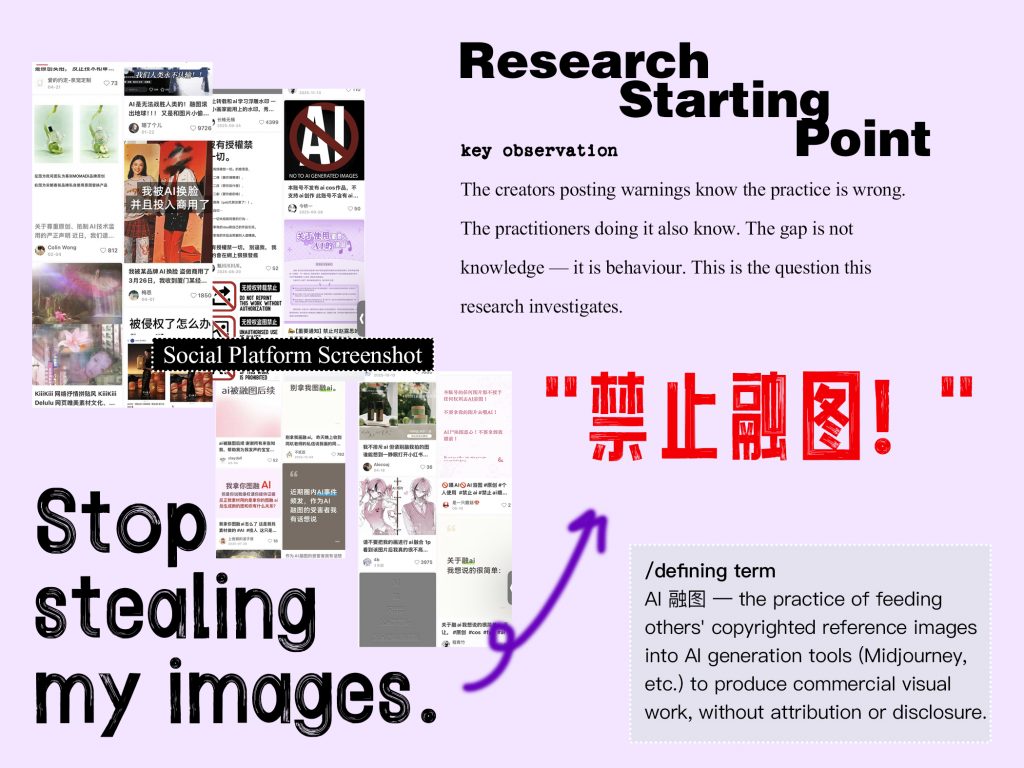
My research looks at what happens when you make the source material behind AI-generated images visible — and what that act of exposure reveals about how the creative industries actually operate. The question I’m working with is: How can transparent creative lineage systems expose the gap between copyright awareness and industry practice in China’s fashion and entertainment industries? The terms that matter here are creative lineage, transparency, copyright consciousness, and the gap between what people know and what they do. The specific practice I’m researching is AI RongTu: feeding others’ copyrighted images into AI generation tools to produce commercial work, without attribution, without disclosure.
WHY
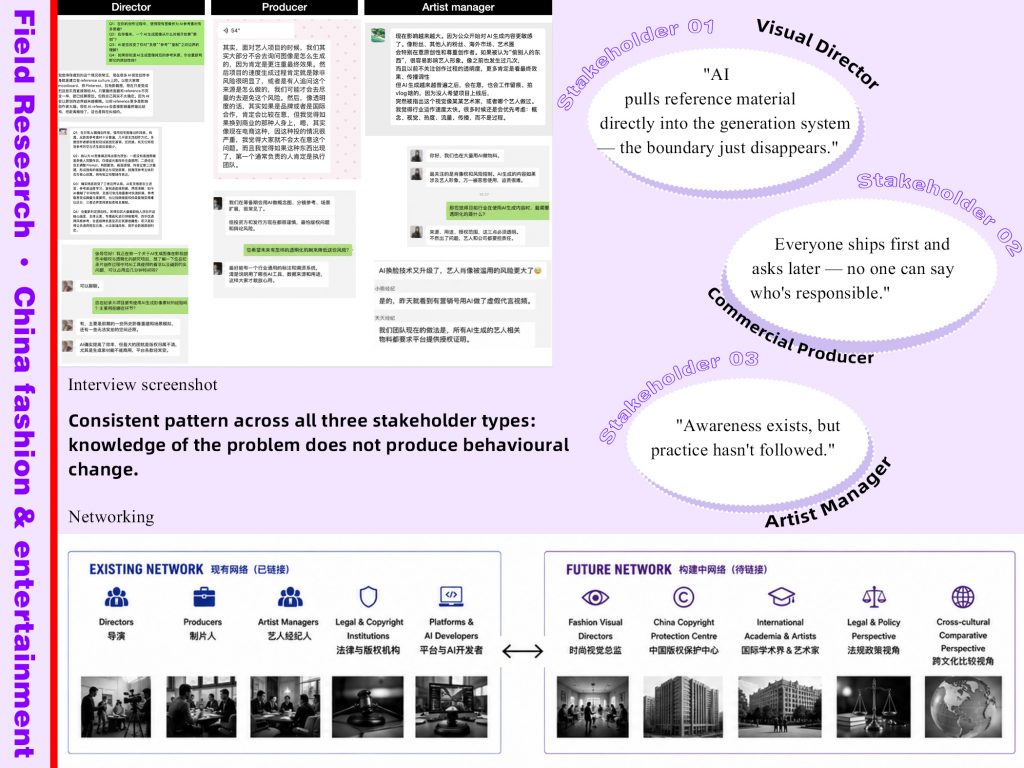
I started noticing this on Xiaohongshu — creators posting “stop stealing my images,” sometimes in desperation, sometimes in anger. Having spent seven years in China’s fashion and entertainment industries, I recognised what they were describing. So I started talking to people I know: visual directors, commercial producers, artist managers. What surprised me wasn’t that anyone defended the practice — nobody did. What surprised me was that everyone described doing it, or tolerating it, anyway. Barthes (1967) gives this a theoretical frame: once creative origin becomes invisible, accountability has nowhere to attach. Hertzmann (2018) pushes this further, arguing that AI authorship complicates but doesn’t dissolve questions of credit and agency. Epstein et al. (2023) suggest generative AI forces a renegotiation of originality itself — who makes something, and who is responsible for it. Wang and Wang (2026) document how rapidly AI tool adoption has moved in China’s entertainment sector, faster than any corresponding norm around attribution.
HOW
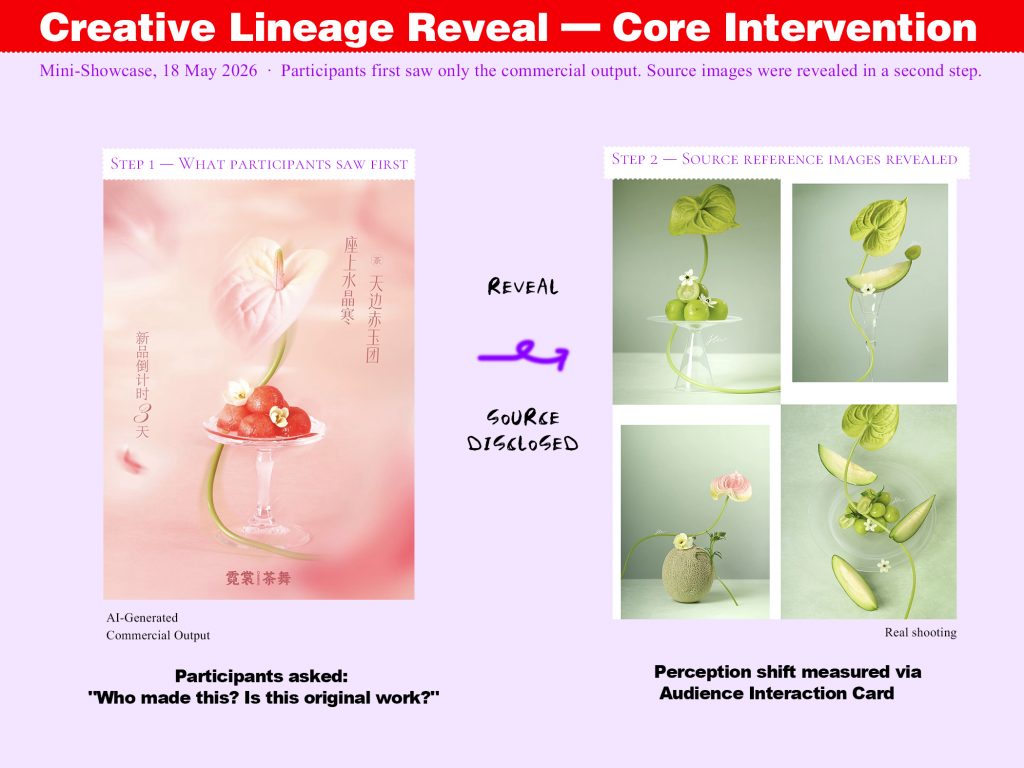
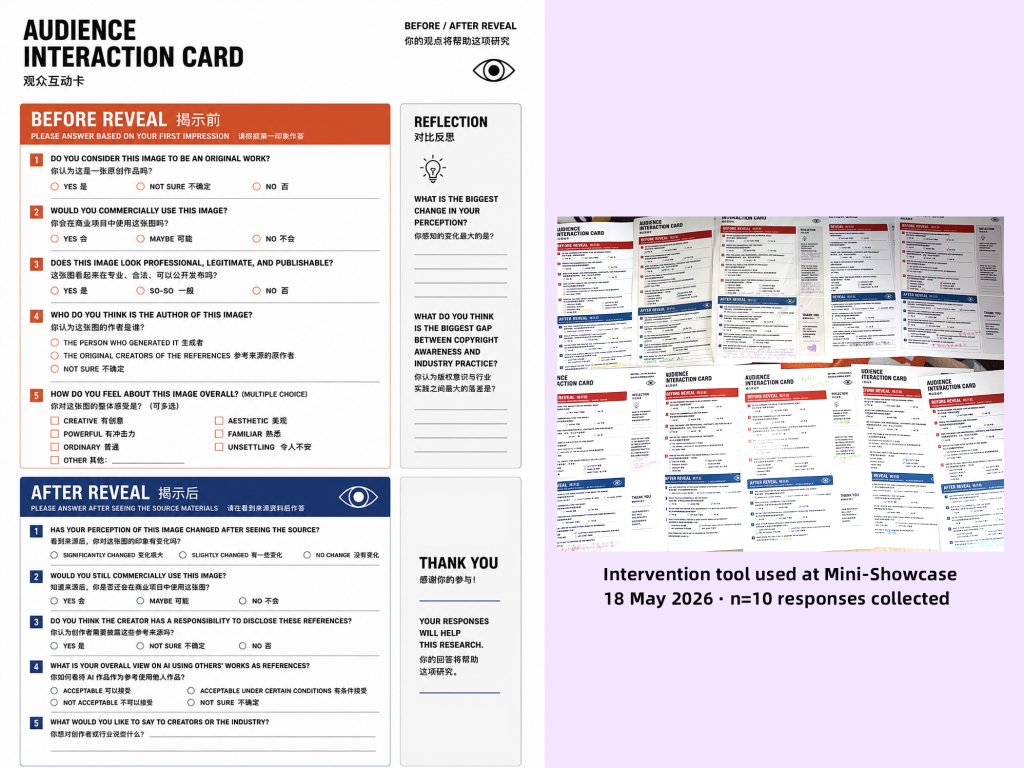
This is practice-led research. At the MA Mini-Showcase on 18 May 2026, I ran an initial intervention: I showed participants a commercially styled AI-generated image, then revealed the source reference images that went into producing it. Fifteen people responded using a bilingual Audience Interaction Card structured around Before Reveal, After Reveal, and Reflection. The responses confirmed that transparency shifts how people read authorship — once the source is visible, the image stops feeling neutral. My tutor’s feedback pushed me on one thing: the test case I used was too clear-cut. The next iteration needs cases where the boundary between reference and copying is genuinely ambiguous. My two research groups are Chinese entertainment creators and MA practitioners at CSM. I’m drawing on Nayar’s (2025) ethics framework for AI-generated content as a way to assess accountability without reducing everything to an obvious moral verdict.
WHAT IF
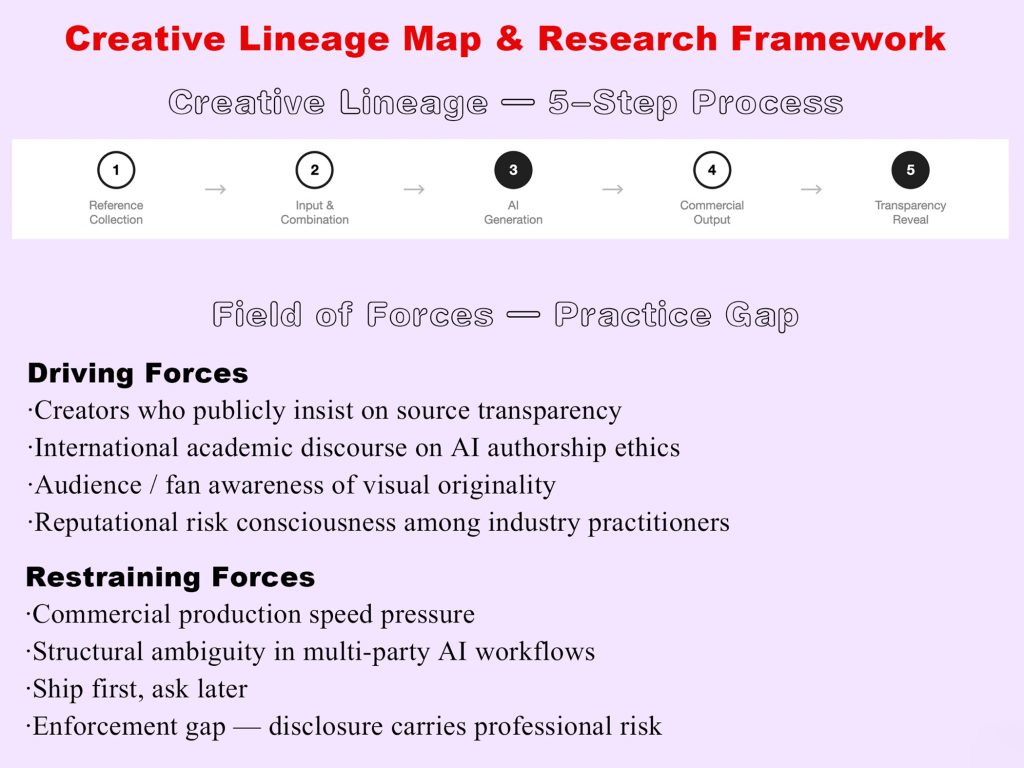
The question I actually want to answer isn’t whether creators should be accountable — that’s not contested. What I want to understand is why the gap persists when everyone already knows. The finding I think matters most might be the enforcement gap: what stops creators from misrepresenting source material when disclosure carries real professional risk? If the intervention shifts perception, that suggests transparency norms could work at an industry level. If people resist even after the reveal, that tells me something more uncomfortable — and more useful — about where the gap actually lives. Either outcome contributes something to AI ethics, visual authorship, and creative industry policy. I also see this as groundwork for a future doctoral proposal.
Bibliography
Barthes, R. (1967) ‘The Death of the Author’, in Heath, S. (trans.) (1977) Image-Music-Text. London: Fontana Press, pp.142–148.
Epstein, Z., Hertzmann, A., Akten, M., Farid, H., Fjeld, J., Frank, M.R., Groh, M., Herman, L., Leach, N., Mahari, R., Oliva, A., Rajani, G., Schroeder, H. and Smith, A. (2023) ‘Art and the science of generative AI’, Science, 380(6650), pp.1110–1111.
Hertzmann, A. (2018) ‘Can computers create art?’, Arts, 7(2), p.18. Available at: https://doi.org/10.3390/arts7020018
Nayar, V. (2025) ‘The ethics of AI generated music: a case study on Suno AI’, Social Impact Papers, 3(1).
Wang, V. and Wang, J. (2026) ‘How A.I. is transforming China’s entertainment industry’, The New York Times, 3 May. Available at: https://www.nytimes.com/2026/05/03/world/asia/china-microdrama-ai-backlash.html
Picture01-Research starting point
Picture02–Creative lineage reveal
Picture03–Audience interaction card
Picture04-Field research
Picture05-Creative lineage map& Resarch framework