Expert Background and Correspondence
Interviewee
孙奥(Aocci),颂艺术中心市场公关经理。
Aocci Sun, Marketing and Communications Manager, Soul Art Center.
Reason for invitation
I invited Aocci Sun because her work involves communicating with artists across different media and introducing their work to audiences. I wanted to understand how this experience could inform my exploration of making human creative contributions more visible in AI-assisted moving image practice.
Correspondence
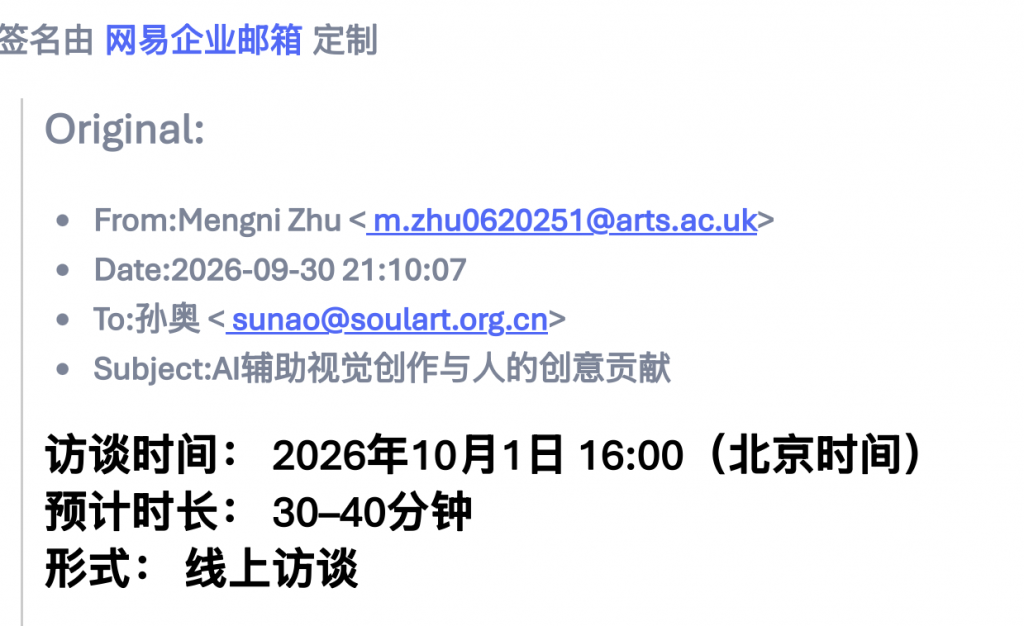
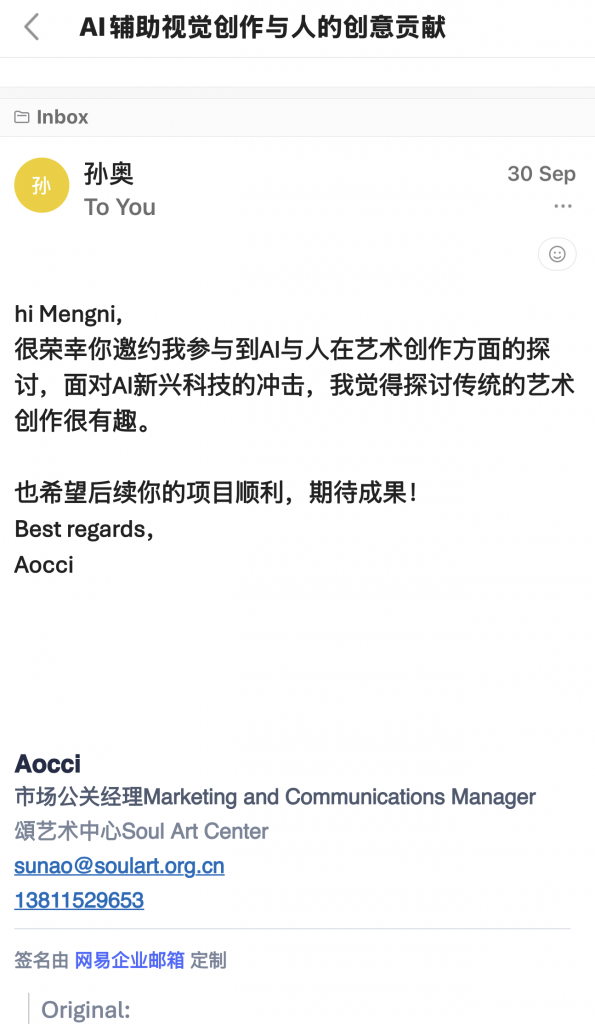
On 30 September 2026, I emailed an introduction to my research, the purpose of the interview and a proposed three-layer presentation: the finished work, human creative contributions and the creator’s own voice. The expert replied positively to the invitation. The email proposed a 30–40-minute online interview for 1 October 2026 at 16:00 Beijing time.
Expert Background and Correspondence
Interviewee: Aocci Sun, Marketing and Communications Manager, Soul Art Center.
I invited Aocci because her work involves communicating with artists working across different media and introducing their work to the public. I was interested in how an art institution communicates the ideas and creative processes behind a finished work, and whether this experience could inform my own research into AI-assisted moving image practice.
On 30 September 2026, I emailed her an introduction to my research and a proposal for a three-layer presentation consisting of the finished work, human creative contributions and the creator’s own voice. She responded positively, and we arranged an online interview for 1 October at 16:00 Beijing time.
The following responses are summaries of our conversation rather than verbatim quotations.
01. When AI is involved in visual creation, what does an art institution focus on?
Aocci described the role of an art institution as connecting artists with audiences. From her professional perspective, whether an artist works with painting, installation or AI, the artist’s inspiration, intention and relationship with the public remain important. General audiences, however, often respond to the visual form of a work before deciding whether to explore its background.
This made me reconsider the order in which I present creative information. As a viewer myself, I do not always read the introduction before looking at an artwork. Sometimes it is the work itself that makes me want to know more.
I therefore became interested in allowing people to experience a moving image before introducing information about its production, rather than explaining everything at the beginning.
02. What behind-the-scenes information helps audiences understand the person behind a work?
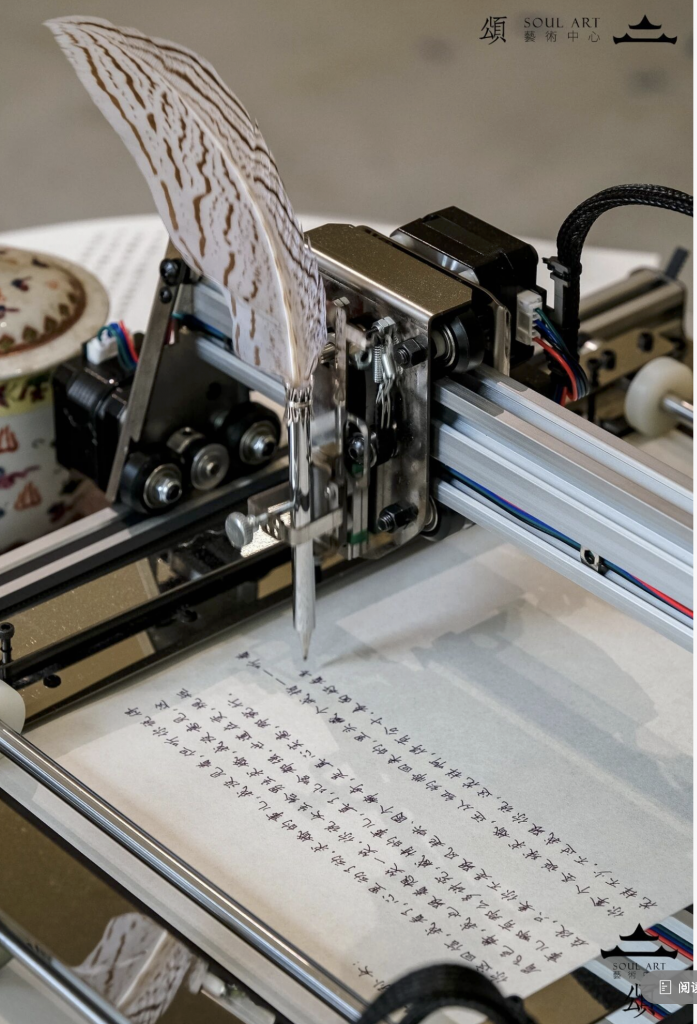
Aocci discussed the importance of creative motivations, personal experiences and emotional relationships. During our conversation, she introduced an installation by Shiliu called Grandpa.
According to her account, the work uses AI to learn the handwriting of the artist’s deceased grandfather and reproduce it through a mechanical writing device. Without knowing the background, a viewer might initially see it as a technological installation. Understanding the artist’s relationship with his grandfather introduces another way of interpreting the work.
I found this example particularly relevant because the use of AI is connected to the reason the work exists. The technology is part of the artist’s expression rather than simply a production method.
In relation to my own research, this made me question whether identifying the tools used in a short film would be enough to communicate the creator’s contribution. Knowing why a particular technology was chosen might be equally important.
Case reference: Shiliu, Grandpa.
03. How can audiences see creative processes that are hidden by the finished work?
Aocci suggested that communicating a creative process should begin with understanding the artist’s ideas through conversation. Story development, sketches, individual production stages and the finished work could then be organised into a more understandable sequence.
She also discussed a Sun Xun exhibition, where a workbench and participatory activities offered audiences opportunities to engage with the making process.
This was useful when I was considering my three-screen presentation. At that stage, I was mainly thinking about separating the finished film, the production process and the creator’s explanation.
The conversation encouraged me to think more carefully about the relationship between these materials. Showing them separately might provide more information, but I also needed to consider how someone could connect a particular creative decision to what they were seeing in the final film.
04. How much information should transparency reveal?
When I asked how much of a creative process should be made public, Aocci did not suggest a fixed standard. Instead, she recommended starting with small-scale audience research to understand people’s initial reactions, what they wanted to know and when they felt they had received enough information.
This was one of the most useful suggestions for developing my subsequent interventions.
At the time, I was considering what information I should include in my own presentation. However, I had mainly approached this question from my position as a creator. I had not yet established whether other people would find the same information useful.
Rather than deciding the content of the presentation entirely by myself, I wanted to investigate how people responded when production information was introduced gradually.
05. Where do human contributions lie in AI-assisted creation?
This question developed during our conversation rather than being a separate question in my original interview plan.
Aocci explained that working with AI still requires people to establish goals, communicate ideas, evaluate generated results and direct further revisions. She particularly emphasised communication skills, logical thinking, aesthetic experience and the ability to guide the creative process.
Her response was closely related to my own experience of working in visual production. During the development of a moving image, many decisions take place before and between the images that eventually appear on screen. Some ideas are developed further, while others are changed or abandoned.
I began to consider whether these moments could become part of the material I presented in my research. Instead of only documenting the tools or prompts used, I could also examine the relationship between an initial intention, the available visual options and the final decision.
However, I still needed to investigate whether showing these materials would actually help someone understand the creator’s contribution.
06. How does an art institution approach AI and other emerging media?
Aocci explained that art institutions are open to emerging media, but the novelty of a medium is not the only consideration when selecting artists or works. Creative ideas, market recognition and market prospects are also relevant.
This was interesting to me because of my professional background in commercial visual production, where creative work is also evaluated in relation to different expectations.
The use of a new technology may attract attention, but it does not necessarily explain the value of a creative idea. Equally, the presence of AI does not tell us how much creative judgement was involved in developing a work.
This distinction became increasingly relevant to my research as I moved away from discussing AI use alone and towards examining human creative contributions.
Reflection
Looking back at this interview, I think its most important contribution to my research was helping me reconsider what creative information needs to communicate.
Before the interview, I had been thinking about transparency largely in terms of making production processes visible. Aocci’s examples encouraged me to pay more attention to creative intention, personal context and the relationship between a decision and its outcome.
The example of Grandpa was particularly useful. Explaining how the installation reproduces handwriting provides information about its production, while explaining why the artist chose to reproduce his grandfather’s handwriting provides a different kind of understanding. Both are relevant, but they communicate different aspects of the work.
This distinction also helped me develop the questions for my subsequent interventions at Hauser & Wirth Somerset and Frieze London. I wanted to explore what people understood from the finished moving image, how they responded to additional production information and what they still wanted to know after receiving it.
However, Aocci’s professional experience comes primarily from art communication and exhibition practice. Her perspective helped me develop my research methods, but it could not establish whether the same approach would be effective in AI-assisted moving image production, particularly within commercial or collaborative projects.
The interview also focused largely on communication between artists and audiences. It did not fully address what creators themselves would want to disclose, how they would communicate their individual contributions within a team, or how clients might use this information.
These became important distinctions as my research developed.
Rather than treating transparency as the disclosure of as much information as possible, I began to approach it as a question of communication: what information is relevant, who needs it, and how it relates to the finished work.